

A
Adam
They provide detailed weekly updates on how the business is performing as well as other valuable nuggets to help scale your business.
Trustpilot
Trustpilot reviewOur process
Reading your account every hour. Senior operators on it every day. An AI brain trained on two hundred ecom stores doing the watch shift no human team can. The reason you stop checking your dashboard.


Illustrative composite based on anonymised client patterns.
Click any line to see how we caught it
Run the same math on YOUR account free, no login
A sample of what our engine catches. Every catch here is a real client win. The accounts are anonymised composites, so no store can be identified. We find it. The team acts. You sleep.
Senior operators read your account every day. Eight AI systems we built in-house watch it around the clock. They cover feed intelligence, anomaly detection, server-side tracking, and a private AI brain trained on 300+ ecom stores. The systems surface what matters. The operators make the call and ship the change.
Reviews
TrustScore 4.8 out of 5 - 38 reviews
Short excerpts from the linked profile. Trustpilot currently labels these reviews Unprompted, not Verified.
Adam
They provide detailed weekly updates on how the business is performing as well as other valuable nuggets to help scale your business.
Max van de Weijgaert
Really great company, nice to work with and really responsive! The results speak for themselves!
Tjade Selman
I expected good but they did record days, switched to a non google css and optimized the entire feed before the week was over. The support is nonstop.
Michael
From setup to management and scaling, they've been on top of every step and helped bring a level of stability and scale to my brands that would've been impossible to achieve on my own.
Bodhi van Klaveren
This agency is the best when it comes down to support.
Peter Pick
Whoever wants to start/scale their business on Google Shopping, this is your guy.
Ivan P
The best thing about working with ZenoX is that I literally don't have to think about or manage Google at all! They take care of absolutely everything, and their fee is very fair.
Stijn de Ruijter
Zenox is one of the best media-buying agency's we worked with so far.
Tobias
Chris and his team are really helpfull, my roas went from 2 sometimes 3, to already a record day of 5 (in the first week) They respond and act fast!
Mo Ait
I started with zero knowledge about Google Ads, and thanks to Zenox Media, I now have a profitable store.
AL
Chris and his team are what you can say the KINGS of Google Ads.
Navroop Singh
Even in such a short time, they've shown a level of professionalism and expertise that's hard to find.
Mdj
From strategy to set up and tracking, he had it mastered.
Julio
Communication is always clear, decisions are data-driven and the team is very proactive when it comes to improving performance and stability.
Christian
Chris and his friendly team, really know their craft, and it's evident in how they communicate and in the outcomes they deliver.
Why this exists
We built them for the same reason we built ZenoX. We were the clients first, and nothing on the market could run two hundred ecom accounts at the standard we needed. Off-the-shelf tools could not see what our team needed to see, fast enough to act on it. So we wrote our own.
Feed intelligence. Adaptive optimization. Real-time anomaly detection. Server-side tracking. Performance labels. Forecast engines. A Shopify app on every store. A private AI brain trained on every account we have ever scaled. Each one is here for one reason. It takes a job off your plate so you never have to think about it again.
Most clients never look at them. They do not need to. The team reads what the systems surface, makes the call, and ships the change. Your job is to keep building the brand.
How we work
01 / 06
Your Slack channel opens the same afternoon and access grants land. The Shopify app installs in about a minute. From the first message you are talking to the operator who will run your account, not to an account manager who will pass it on.
02 / 06
Tracking goes in. The audit engine pulls spend, conversions, search terms, feed health, tracking integrity and Merchant Center issues. Every signal gets checked against patterns from two hundred other ecom stores, so we know what good looks like in your niche. Then a senior operator reads the raw output and writes the plan.
03 / 06
The feed first, because that is what Google actually bids on. Then the products quietly burning budget get stopped. Then the structure gets rebuilt around what the data says. Tracking goes server-side. Negatives ship at scale. Every product gets a performance label. The account is unrecognisable by the end of day three.
04 / 06
Campaigns run. Anomaly thresholds calibrate to your account. The engine starts reading every hour for spend spikes, return drops, feed errors and tracking breaks. Then Google takes its turn, and Google is the slow part. It needs roughly two to four weeks to relearn before the numbers settle. That is our estimate from 300+ stores, not a figure Google publishes.
05 / 06
The engine reads the account every hour. The team reads it every morning. Anomaly detection, search-term mining, autofix on disapprovals, budget impact simulations, all running while you build the brand. You stop checking the dashboard, because someone is already looking.
06 / 06
The forecast model tells us which winners can take twice the budget without the ROAS cratering. The duplicator clones top SKUs into adjacent campaigns. The risk model flags accounts trending toward CPA inflation before it shows up in the numbers. Scaling stops being a decision you have to make on gut.
A day on your account
One ordinary Tuesday. The engine and the team do the work. You do not get a single ping.
A Champion product's ROAS slips 18% overnight. The engine flags it before the market opens. No human was awake. It did not need one.
The morning brief is already sorted by what matters. Your operator sees the dip, checks the feed, and shifts budget to the winners. Ten minutes. Done.
Merchant Center flags a variant price mismatch. The autofix clears it in nine minutes. The product never left the auction. You never saw the warning.
The forecast says one Performance Max campaign can take 35% more budget without the ROAS cratering. The team pushes it. The number climbs.
No panic email. No 2am ping. No dashboard refresh. The account had a good day. You spent it building the brand.
The engine
Each system was built for one reason: something your account needed, that nothing on the market could deliver. They run quietly underneath. Open any one to see what it does for your store.
Day one, you ship the cleanest Shopping feed in your niche.
Generated straight from your Shopify catalog, validated against Merchant Center rules before anything reaches Google, and tuned per channel. Lower disapprovals. Higher feed score. Better impression share before a single optimization has run. The first thing your account ships, and the first thing that compounds.
Your product data, written in the language that converts.
Reads the queries that actually drive your sales, then rewrites titles, categories, and attributes around them. Every change measured against a fourteen-day baseline. Anything that does not lift performance reverts itself. You scale what works, automatically. Nothing gets to underperform quietly.
Your best products take more of the carousel.
We clone your top twenty converters into four distinct title variants each, ship them as a supplemental feed, and let Google pick the winners. Each variant can win its own carousel slot, so one top product can show up more than once on the same search. The same products you already sell, with more shelf space.
The tracking layer that survives every iOS and cookie deprecation.
Pixel and Shopify webhooks pipe into our tracking layer. Conversions get normalized, enriched, and shipped to Google Ads enhanced conversions in sixty-second batches. First-party. Encrypted end to end. Smart Bidding sees more, your CPA stops drifting, and the data still works after the next browser change.
Every product, sorted into the five buckets that decide budget.
Every SKU sorts itself into Champion, Potential, Sleeper, Waster, or Zombie. Thresholds tuned per account, per niche. The labels ship to Merchant Center as custom_label_0, ready for campaign targeting. You stop spending the same money on every product. Champions get scaled. Wasters get cut. Sleepers get a fair shot.
Your account, watched every hour. Healed where we can.
Hourly scans for spend spikes, ROAS drops over thirty percent, zero-conversion days, feed disapprovals, and tracking breaks. High-confidence issues fix themselves. Everything else pings the team in Slack before it reaches your dashboard. You get the calm of an account being watched. We get the moments that actually need a human.
Where the next month is going, before the next month gets here.
Seven and fourteen-day revenue forecasts with confidence bands. A zero to one hundred risk score per account, drawn from ROAS trend, conversion volume, and spend stability. Backtested every night against what actually happened. Decisions get made before the numbers tell you to make them.
Disapprovals fixed before they bite.
Six built-in fix strategies, more shipping. Title shortening, category correction, color and size population. Every change confidence-scored before it writes. A kill-switch trips if rollbacks spike past ten percent in a week. The disapprovals that used to kill a Friday afternoon disappear in the background.
Every account begins with one install. From there, clean feeds, server-side tracking, performance labels, and anomaly hooks all run through your store. No theme edits. No dev tickets. No Friday-afternoon emergencies.
Installs in 60 Seconds
One click in Shopify admin. No dev work. No theme edits. Pixel, webhooks, and feed sync go live in under a minute.
Feed Generation, Native to Your Catalog
Generated straight from your products. Per-channel rules. Validated against Merchant Center before anything goes live. The cleanest Shopping feed in your niche, written from your own catalog.
Server-Side Tracking, No Code
Pixel and Shopify webhooks pipe straight into our tracking layer. First-party data. No third-party cookies. Enhanced conversions reach Google Ads in sixty-second batches.
Performance Labels, Written Back to Shopify
Champion, Potential, Sleeper, Waster, Zombie. Labels land in product metafields and on Merchant Center as custom_label_0. Campaigns, collections, and segments target them automatically.
Shopify app
ZenoX
Feed intelligence + server-side tracking + performance labels
Installed on 300+ ecom stores
What it ships
What 300+ ecom stores install on day one. No dev work. No theme edits. The rails go live in under a minute.
The Brain is the reasoning layer inside ZenoX AI. Built in-house. Trained on every store we have ever scaled. It reads patterns no human team can spot in time. Search-term shifts, feed drift, conversion drops, ROAS curves cratering hours before they show up on your dashboard. It tells the team what to do. The team makes the call. You get the win.
Trained on the Entire ZenoX Portfolio
Every search term, every feed mutation, every Smart Bidding curve from two hundred ecom stores has trained the model. By the time it reaches your account, it has already seen what works in your niche, dozens of times over.
Sees Problems Before They Happen
Forecast collapse, ROAS cratering, feed disapproval cascades. Flagged hours before they reach your dashboard. The team gets the alert. You stay scaled. You never get the panic email at 2am.
Decides What We Test Next
Every morning, the Brain surfaces the three biggest moves on your account. The team picks the call. You get the win. No gut feel. No Monday morning meetings about what to try next.
Illustrative sample - this is how a morning brief looks. Real client numbers stay private. The Brain is internal. The team acts on it.
Delivered to you
No dashboard to learn. No Monday PowerPoint. The team watches the live screen every day, and what matters reaches you as a plain weekly report and a ranked game plan.
€4,820
+6.2%3.74x
+0.31182
+18The screen our team watches. Illustrative - real data on your account.
Spend, ROAS, conversions, CPA. The same numbers the team watches live, written up plain every week.
Where you land this month against the goal you set. Sent with the report, confidence bands and all.
Every issue the engine flagged and every fix it made. You hear about it once it's handled, not before.
Champion, Potential, Sleeper, Waster, Zombie. Which of your products earn, which drain, how many of each.
The three moves the Brain ranked highest, the reasoning behind them, and what the team already shipped.
Same Tuesday. Same goal. Three different ways to get there. The systems below are running on your account from week two.
Performance fee, senior team, AI engine on every account.
Flat retainer, account managers, junior buyers behind the scenes.
Salaried hires, recruiting cycle, you train the senior buyer.
One machine, five parts
You just walked the whole process. Under it runs one engine. Eight systems under the hood, five parts you can see, all feeding the same goal. Open any part to see it up close.
One machine, running your account start to finish. No rented tools bolted on. No gaps between the parts.
The Product-Level Edge
The ceiling can move every week. Our systems watch the products underneath the account, so the scale plan does not stay stuck in last month's report.
It puts real Google spend beside real Shopify revenue, per product, and shows where to scale next.
In one week on one real account, 14 products started winning, 18 winners faded and 4 quietly bled budget. The Hub shows those shifts while they can still change the next decision. You stop raising a whole campaign because yesterday's winner made the blended number look safe.
The account stops having a ceiling made of guesswork, and you stop being the person who has to guess.
It sharpens each product feed attribute against the searches that actually convert for that store.
Better product data gives the right items a better chance of looking like the right answer when someone is comparing. That removes the manual feed work that keeps owners and normal account teams trapped in spreadsheets. Your scale plan gets a stronger base before another euro enters the campaign.
You stop trying to buy your way past a feed problem with more budget.
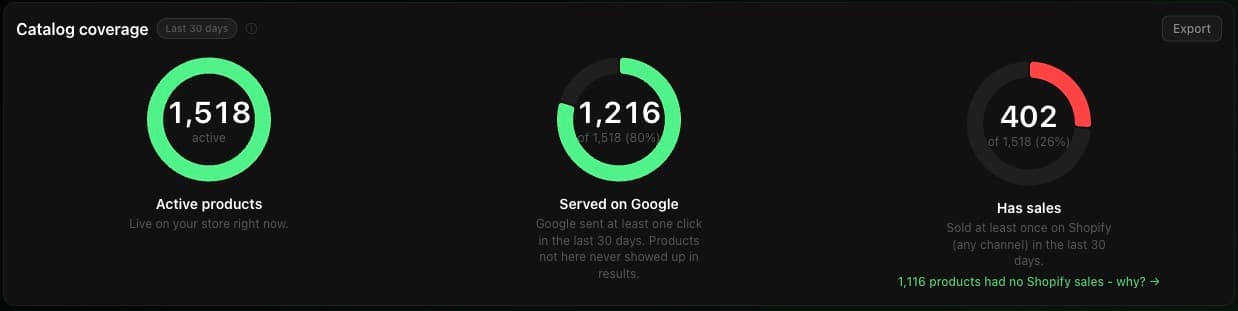
Catalog Coverage
Three rings: live on the store, ever served by Google, sold in 30 days. On one account we opened, 1,518 were live, Google had served 1,216, only 402 had sold anything, and 1,116 had no Shopify sales at all in that window. If you are scaling "the catalog", it is worth checking which catalog you actually mean.
You stop raising budget on the slice that already appears, while the rest of the store sits dark.
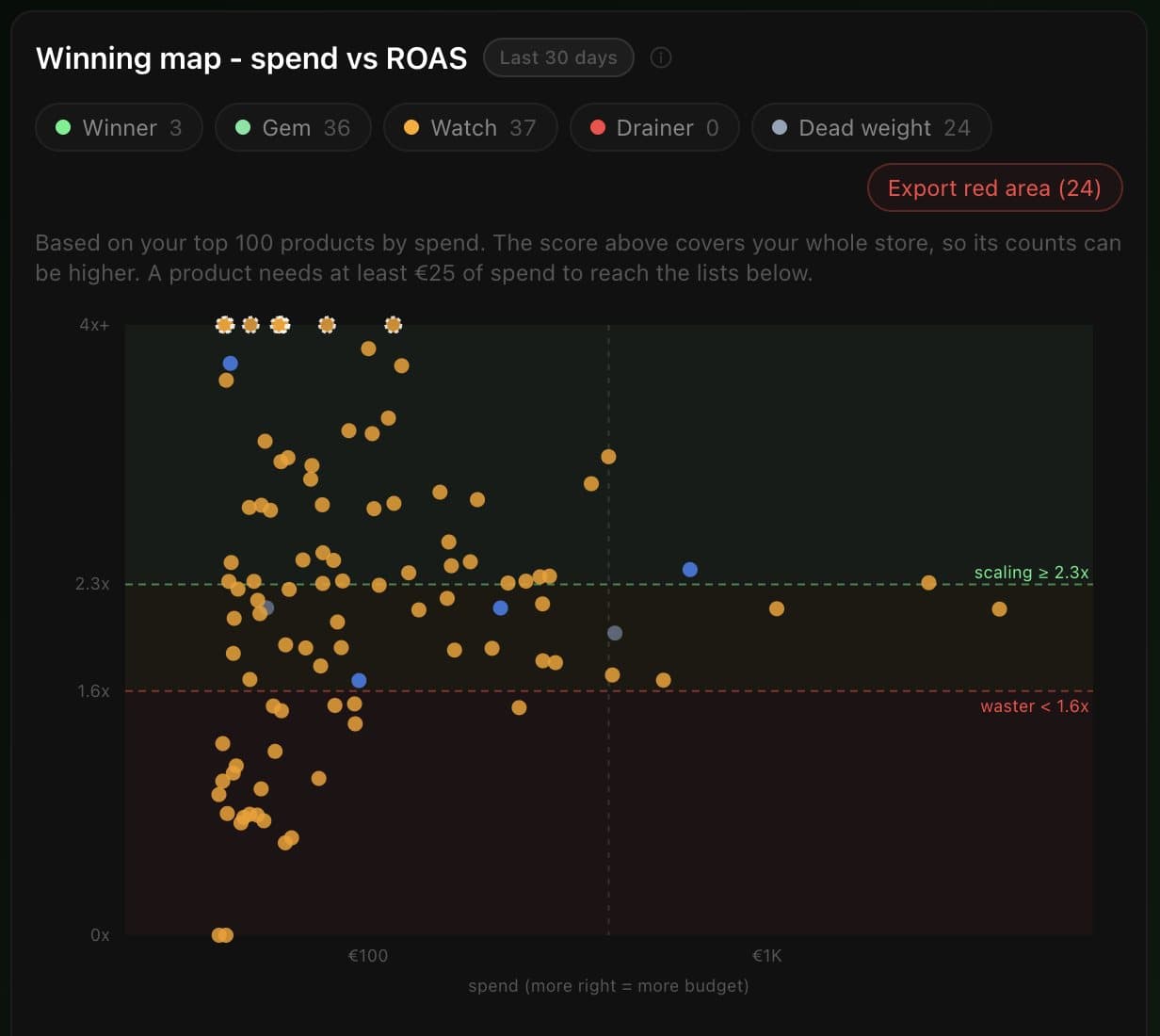
The Winning Map
Every product with real spend sits on a map of what it costs against what it returns, with clear lines for scaling and for waste. On that account it showed 3 winners, 36 gems, 37 to watch and 24 dead weight. Beside it, a scaling score of 61.1 out of 100, reading "you are holding, winners and drainers are about even".
You raise a budget because you can point at the reason, not because the month looked calm.
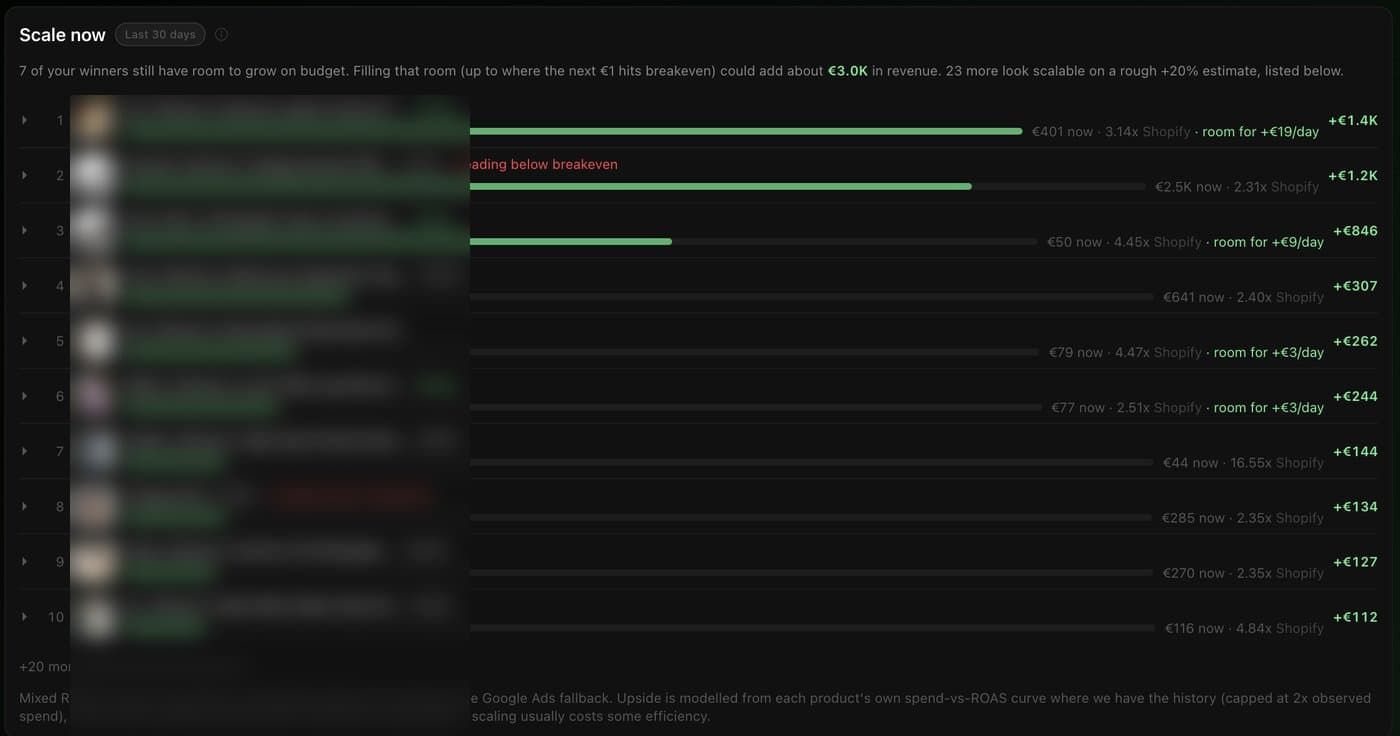
Scale Now
The table ranks the winners that still have room, showing what each spends today, what it returns, and the daily room left before the next euro stops paying. On that account, seven winners still had room worth about €3,000 in revenue, with 23 more marked scalable. Product names are blurred here.
When an opening appears, you do not have to find it yourself before it closes.
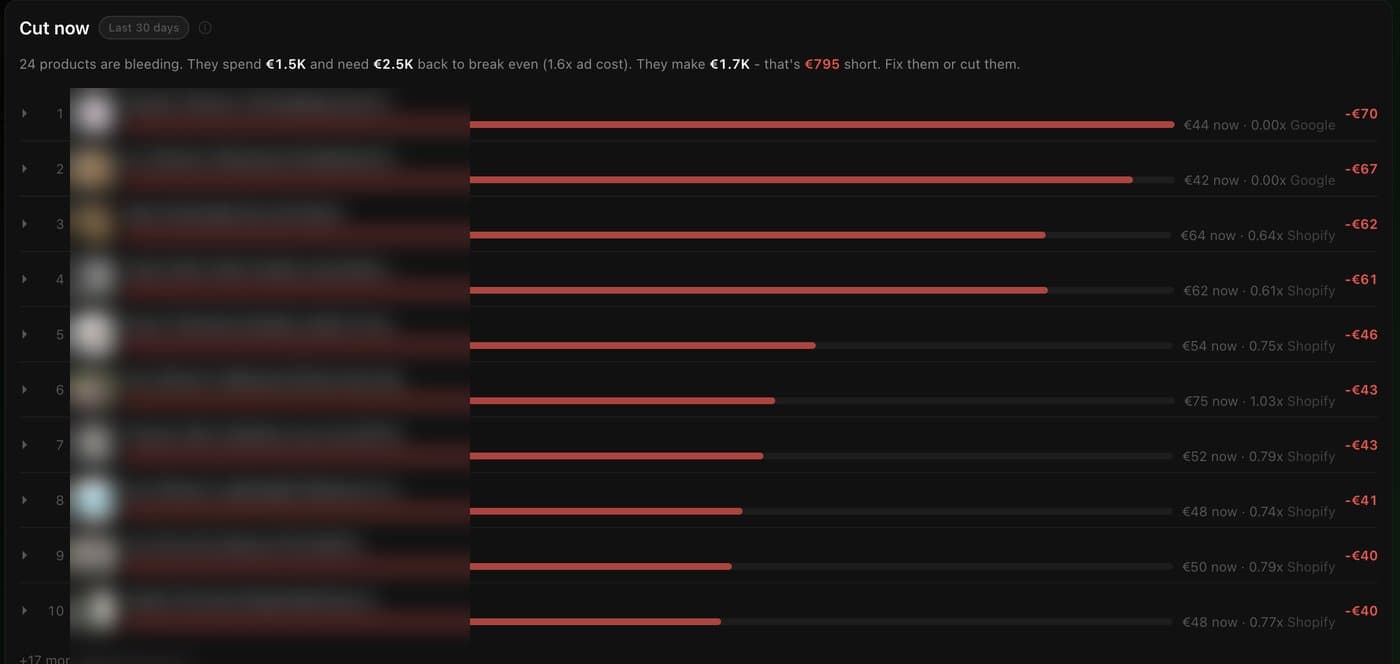
Cut Now
The same view, turned around. On that account, 24 products were bleeding: they had spent €1,500 and needed €2,500 back just to break even. They made €1,700. None of that moves a blended number enough for anyone to notice.
You stop funding the losers out of the winners' budget.
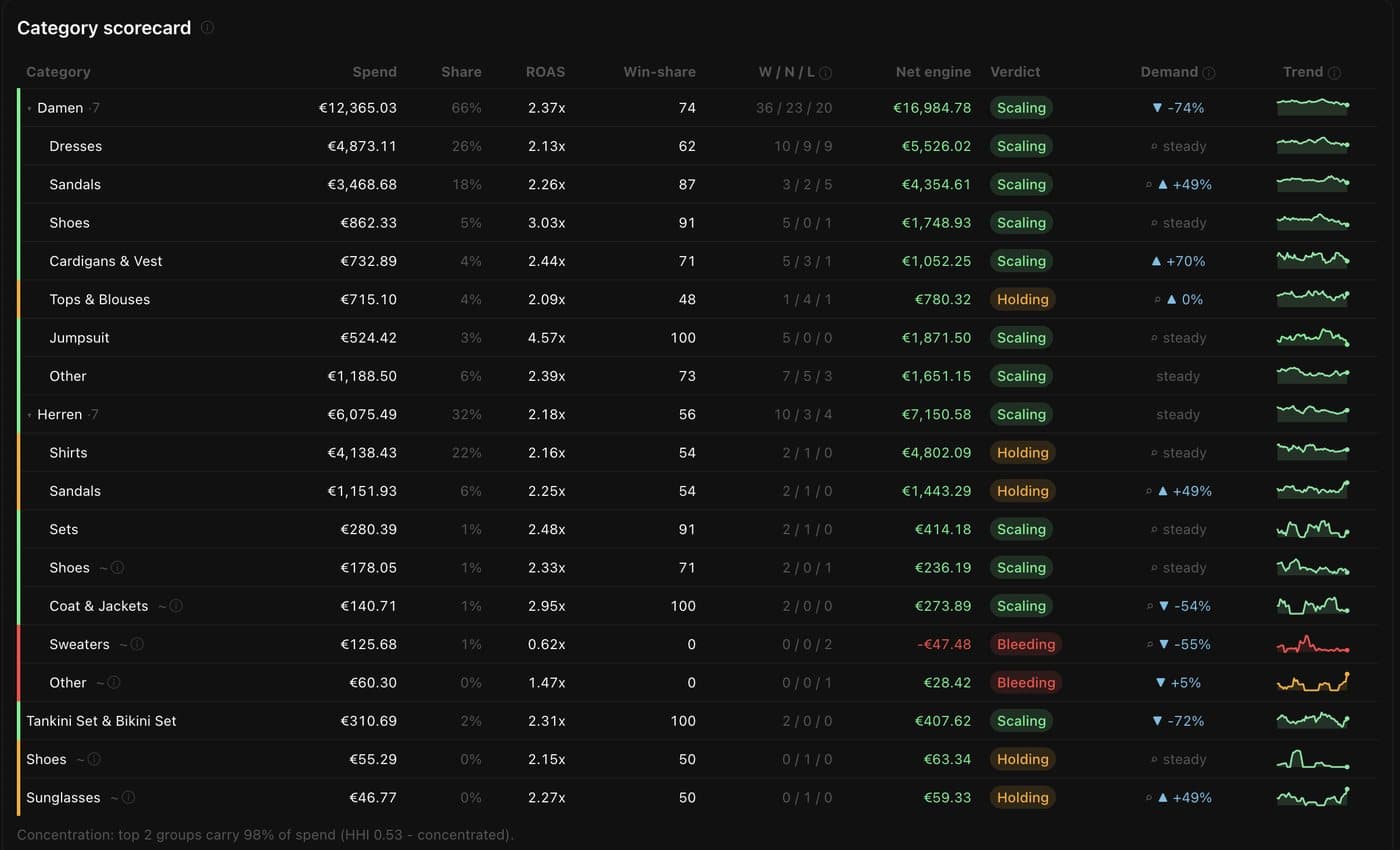
Category Trends
One view shows where the money sits by category. The next scores each one on spend, share, return, net after ad cost, a scaling, holding or bleeding verdict, and which way demand moved. In the same store, in the same month, those moves ran from plus 70% to minus 74%.
A slow category does not get to turn into a bad month while nobody is looking.
Peer Benchmarks
Cost per click, order value and conversion rate, each checked against real stores in the same niche and the same country. On that account, click cost ran 24% above peers while order value was 4% better and conversion rate 11% better, across roughly 170 stores. That points at the click, not the shop.
You stop paying to solve the wrong problem.
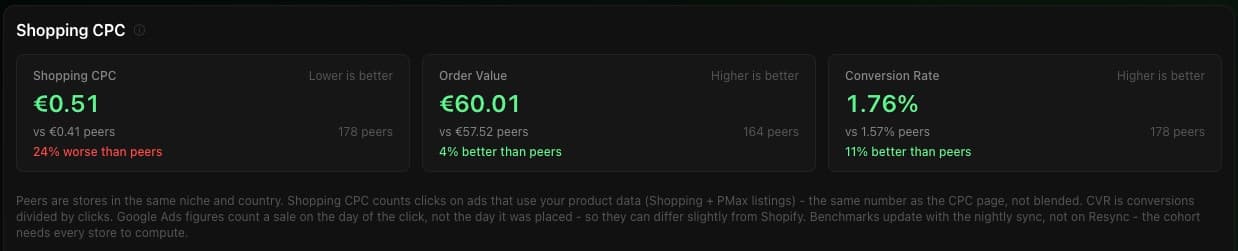
The screenshots show one real client account with the name removed. These figures are not a benchmark or a promise.
A solo owner, or a normal agency reading one account at a time, cannot copy that pattern base. These systems read across 300+ ecom stores every day, so one store gets the benefit of shifts it could never see alone.
The questions everyone asks
Ready to see the engine run on your account?
A thirty-minute call. We run your account through the audit engine live. You watch the Brain surface the leaks in real time, and the team write the rebuild plan in front of you.
If we can scale you, we will tell you how. If we cannot, we will tell you that too.
Go deeper